Kaggriculture An agent that plans ahead by simulating the real rules. Nine versions, each built to beat the last.

Kaggriculture is a two-player Kaggle competition: farm a shared board, sell into a moving market, out-earn an opponent over 720 turns. I built a simulator that matches the real engine exactly, then a planner that searches ahead through it instead of reacting turn by turn.

Stack
Python · kaggle-environments · React strategy desk
Status
Open source · GitHub ↗︎
  • 9agent versions
  • 720turns per season
  • 1,738lines of Python

Kaggriculture

Python · kaggle-environmentsView code
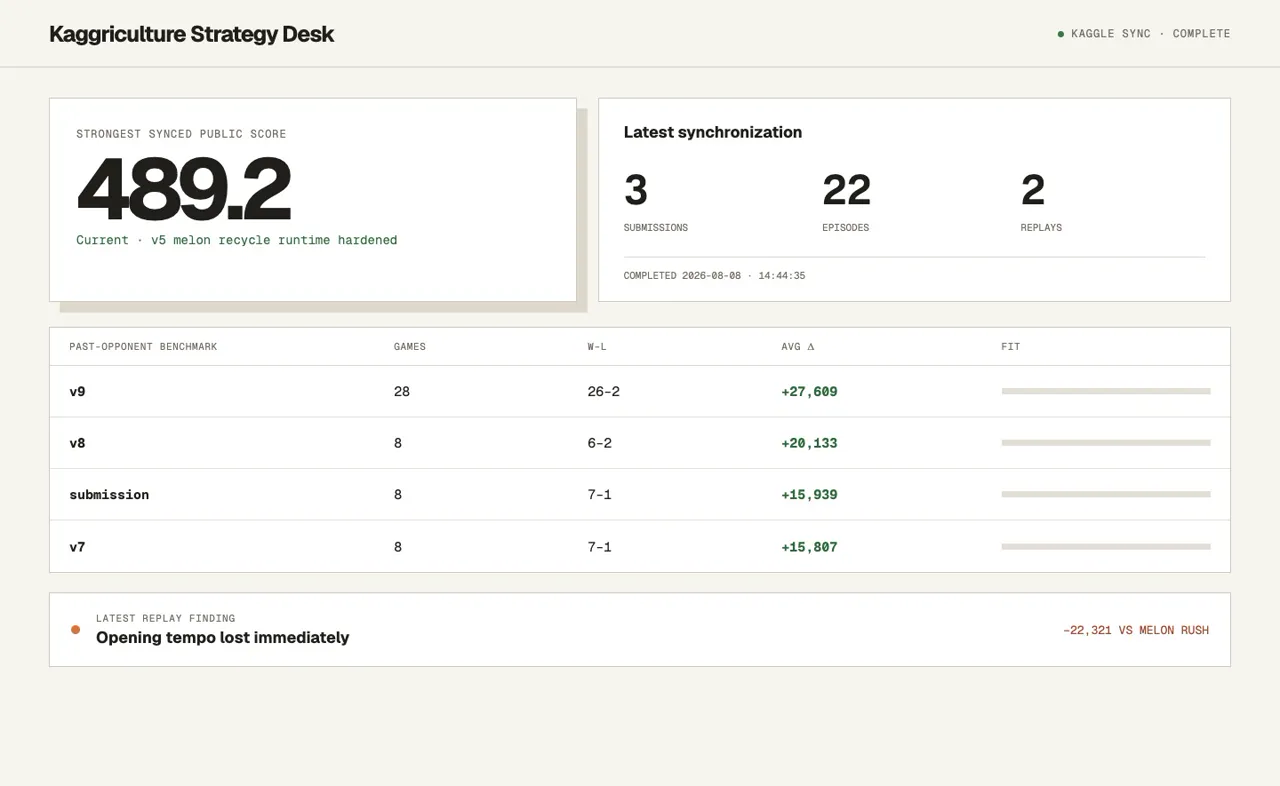
Kaggriculture: a farming-game strategy desk showing simulation episodes and opponent benchmarks

01 · Problem

A reactive agent can't see the trap it's walking into.

Land, water, harvest, sell, repeat: an agent that only reacts to the current turn buys land too late, plants the wrong crop for the days left in the season, or gets outpaced by a competitor at the market.

02 · Solution

Simulate first, then search through the simulation.

A deterministic simulator reproduces the game's rules, checked turn by turn against Kaggle's own engine. A planner searches move sequences through it, models the opponent, and hands off to an emergency handler near the end of the season.

03 · Engineering

Tests assert the simulator against Kaggle's real engine turn by turn, so a planner search through it searches the actual rules, not an approximation.

04 · Key decisions

  • Simulator validated, exact-match vs. real engine
  • Opponent modeled by rollouts, not a formula
  • Data-driven thresholds, not hardcoded guesses
  • Endgame guard, added after two timing bugs
  • Nine agent versions, each beating the last

Engineering note

The planner earned its search budget one phase at a time. Ten phases in three days, each one validated before the next began.

Phase 2 checked the price formula against the live engine before Phase 3 trusted the simulator to search through. Phase 5's planner had to beat every earlier agent before it became the baseline, and Phase 9 replaced a discount-formula guess at the opponent with rollouts of its own policy.