01 · Problem
Wearables report numbers, not what to do.
An Apple Watch records sleep, heart-rate variability, resting heart rate and steps, but raw numbers don't say whether today is a day for deep work, or when in the day to do it.
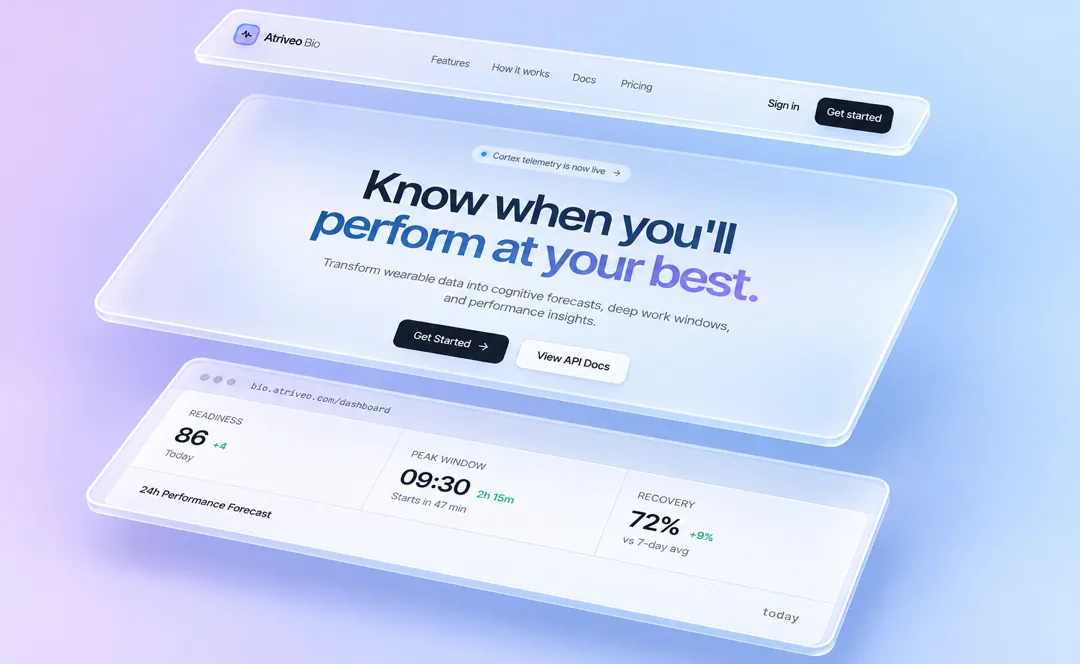
An iPhone app syncs HealthKit data to an API that builds a personal feature store: sleep, HRV, resting heart rate and activity, each against your own 30-day baseline. From that it scores readiness, estimates your chronotype and forecasts the day's best deep-work window.
Wearables report numbers, not what to do.
An Apple Watch records sleep, heart-rate variability, resting heart rate and steps, but raw numbers don't say whether today is a day for deep work, or when in the day to do it.
Compare you with you, then explain the score.
Samples land append-only, roll up into daily and hourly features, and are compared with 30-day personal baselines. Readiness is a rules-based score that returns its reasons, such as “Strong sleep +12” or “Short sleep −15”.
Each sync recomputes features for the days it touched. Sleep uses the night's longest session, so naps don't count twice.
Machine learning had to earn its place. Every model is scored against yesterday, a 7-day average and the rules.
The training script fits XGBoost on sleep, HRV, activity, chronotype and weekday, then records whether it beat all three baselines. Until a model does, the explainable rules-based score stays the default.